Archive | Uncategorized RSS feed for this section

Ah, ah, ah, ah. Stayin’ Alive, Stayin’ Alive.

3 Apr

Our herbs, that is!

Class is tonight, and I’m very excited! I think we’ll have a good size class. It’s not just about planting herbs to use in cooking, but part of the activity will be decorating the planters. Yes, full grown adults will be using paint markers, hot glue, giant rhinestones, and I don’t even know what other art and craft supplies are waiting for us. There’s something soothing about each aspect of tomorrow evening: the plants, the markers, the conversation, the wine…. 🍷

But bringing a bit of green into an apartment is always nice. Keeping it alive and healthy is an ongoing chore/battle/challenge/task, depending on the level of obligation you feel. Regardless of your love for your little pot of herbs, they’ll all need light, water, and food. Here’s a brief primmer on each. I’m going to include a few links here and there. I’ll grab them from a few places online, but I don’t have any relationship with any of these place and don’t make any money from any links. That would be super, but I don’t.

Light

A sunny window probably won’t be enough light for most herbs. Even a bright south facing window would only work for part of the year. Most glass will block out some of the sun’s rays. If you’ve ever tried to grow basil inside and you wound up with loooong stems and just a few leaves facing the outside, it was searching for more light! For the most control and flexibility in where you place your herbs, I’d highly recommend grow lights. 12 hours a day is fine for year-round growth, but even 8 hours is ok. Then they’ll need some time to sleep. Lights that offer a full spectrum of light that mimics the sun are your best bet for your indoor adult herb garden.

Many lights now have built in timers that will automatically cycle on and off, but you can also pick up traditional timers that you plug in to the socket and then plug your light in. I really like using bluetooth timers. They connect to my wifi and then I control them with my phone. I have several sets around my home and can control each one precisely.

You don’t have to get too complicated here. There are many inexpensive options, including clip on lamps, long strip bulbs that will fit under a shelf, hanging fixtures for tall structures, and floor lamps.

Water

Drainage is key. The pots we have selected for our herbs have good drainage at the bottom, but in general you don’t want to overwater. Root rot means death! Water every three to four days, depending on how dry your room is, but wait until the top inch or so is dry before watering again. If your soil feels like a wrung out sponge, that’s perfect! If your soil still feels a little damp at day 4, check it again in 12 hours, and then 12 hours after that. Be slow and consistent in watering. Too much at once will immediately flow through your pot and make it seem like you’ve over watered, when in fact your soil just isn’t able to absorb it all. Too little won’t soak through to your roots. You can divide your watering into two “sips” with a few minutes apart to help absorption. If you see droopy leaves, your little guys are thirsty. Water in several sips over about 30 minutes and then wait a few hours. They should start to perk up.

Food

Plants need not just water, but some food, too. You should feed your guys every 2-4 weeks or so. You can use an all purpose liquid plant food during a regular watering time, diluted to about half of the recommended strength. Liquids are immediately available to plants, instead of a slow release pelleted food that will have to slowly break down in your soil over time. You can buy a little bottle and it will last a long time! Here are some options. Again, I have no connections to any of these links, they’re just examples of the brands.

  • I used this organic fish fertilizer to grow our herbs. It’s amazing, but extra stinky. It’ll be fine if you’re not growing 6 flats, though! Great for other houseplants, too. Again, I dilute it to about half the recommended strength.
  • I haven’t use this particular type of Espoma food, but I really like their other products, so I’d probably give this tomato and vegetable food a try . I use many of their foods and fertilizers for outdoor gardening, and used their seed starting mix for our herbs.
  • Here is a pump food. Apply right to the soil, then water over it. No separate measuring.
  • I haven’t used this brand myself, but I know people like it a lot.

Next post…how to harvest!
Deliciously Stinky Fishy Fertilizer

13 Mar

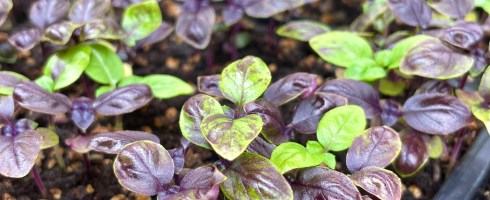
I knew this stuff was going to smell, but wow. At the advice of one of my garden wizard friends, I fed my babies. I should have thought of it, but I did not. I’m glad I have her to coach me. So, two weeks ago I mixed up some organic liquid fish fertilizer at 1/2 strength and then soaked the cell flats for about an hour at a time in the solid trays to bottom water before putting them back in their mesh trays for proper air flow.

We’ve had two feedings so far, and all of the herbs have responded very well. Everyone is perky and we’ve had significant growth since then, so I think we’ll be ready to go right on time. They’ve had a nice watering since then, as well. That will probably be all for feeding before they go to their new homes, but we’ll see. The ProMix soil I’m planning to use to pot them doesn’t have food, so I might wind up using something different.

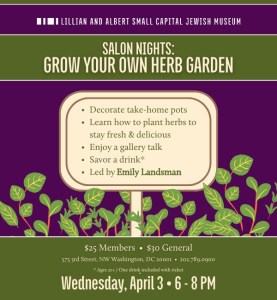
Tickets are now on sale for my Herb Garden class at The Lillian and Albert Small Capital Jewish Museum on April 3! You can decorate a fun planter and take these babies home with you to grow and enjoy in your meals.

True Leaves!

7 Feb

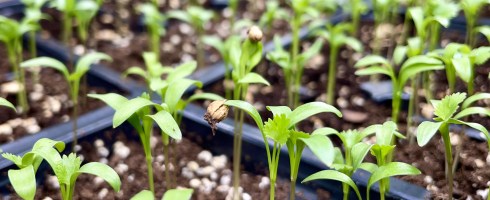
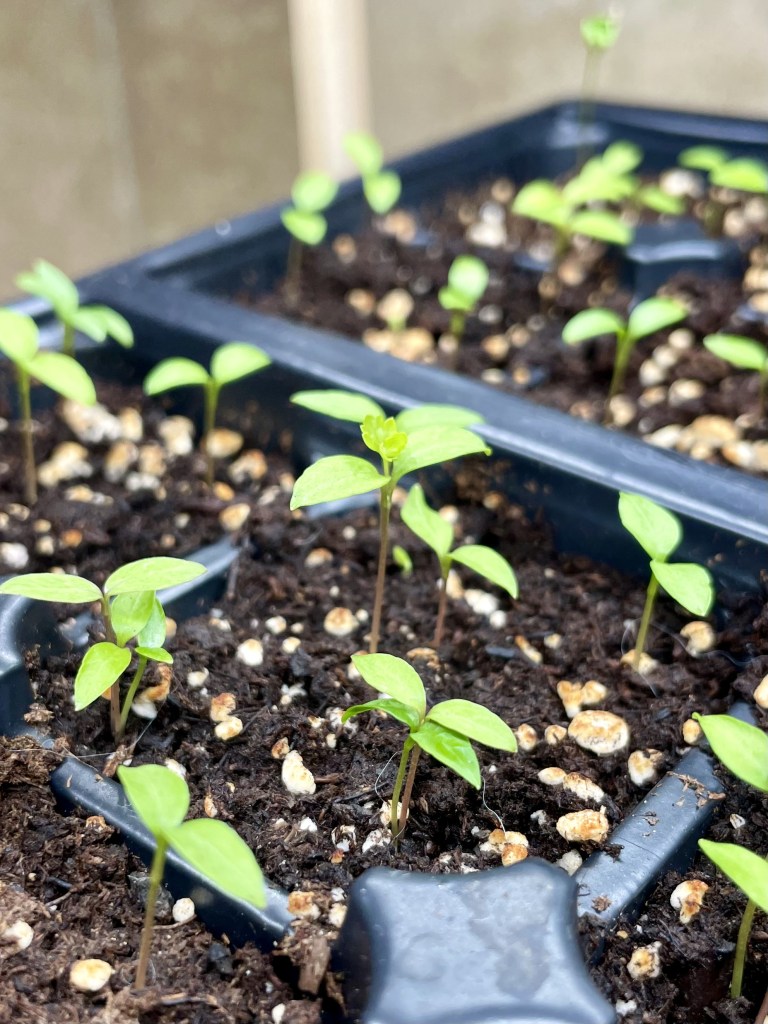
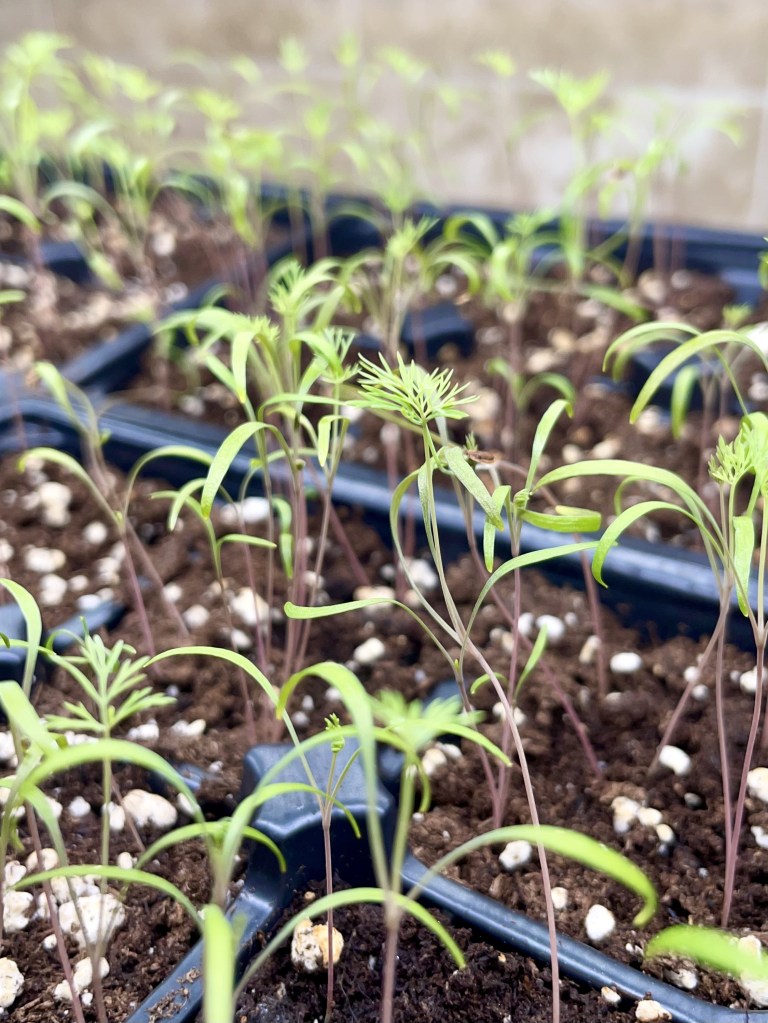
I feel like a proud parent. My little guys are starting to show their true leaves! When seedlings emerge, the first set of leaves is called the cotyledon. Those are basically the embryonic leaves that they start out with. True leaves are the first “real” leaves and will look like tiny versions of the adult plant. SO ADORBS! I only see one parsley, but they’re a bit slower anyway so I’m not worried.

I also added a fan to make sure the air moves around and I don’t have a moisture issue. It’s also important to keep the plants moving a little bit all the time so they get strong and don’t get super leggy. As the little guys grow I’ll start watering a little more frequently. Problem with this fan is it only goes back and forth horizontally, and it is also REALLY strong. I move it daily and rotate the trays, but I don’t think I’ll be able to keep it up. I tried keeping the shower curtain closed to create kind of a wind tunnel thing, but it wasn’t ideal. Also the fan tripped the GFCI outlet twice turning on and off. SO…I’m in the market for two smaller fans now.

Welcome new seedlings!

29 Jan

Lots of progress! We’ve sold several tickets for the April 3 herb garden class already, so everything seems to be moving along nicely.

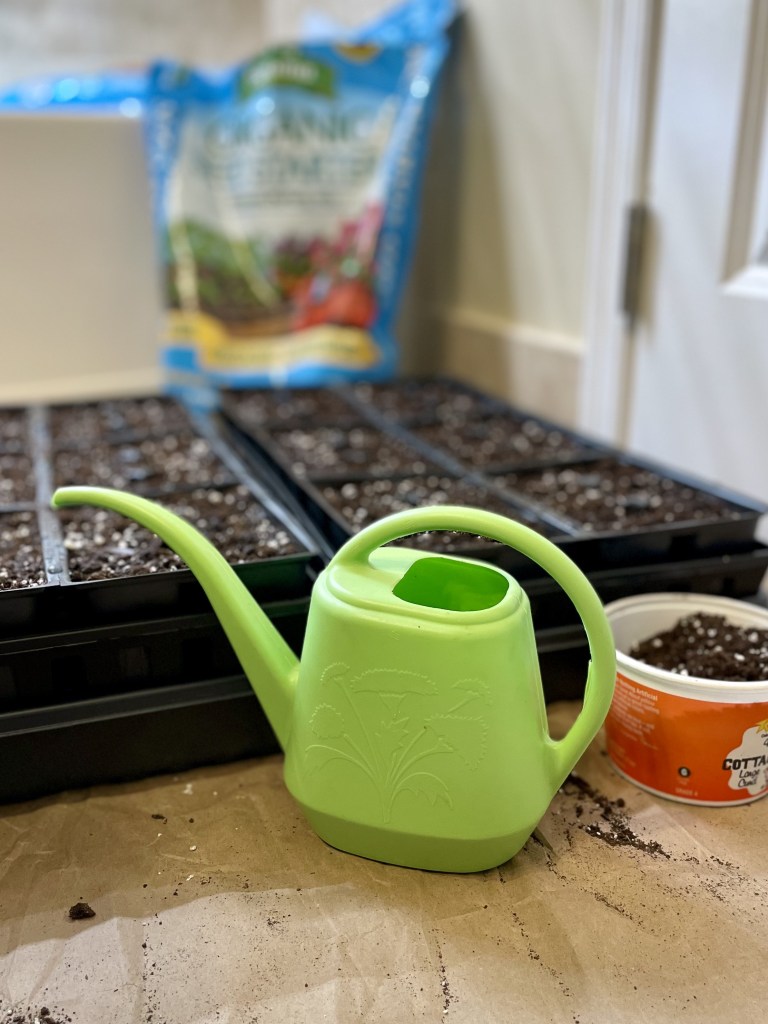
On January 15, I planted a full flat each of cilantro, dill, and parsley. I started with these three because they’re usually slower to germinate than basil, which I wound up starting on January 19. A little tricky with everything on the bathroom floor, but it worked out. I filled the trays with seed starting mix right to the top, tapped to settle, and the topped them off. Heavy water and let extra drip through to the bottom solid tray. Then I made holes in the soil and planted 5-8 seeds in each cell and covered each tray with a piece of heavy plastic to keep in moisture. As soon as I saw little green popping up a few days later, I removed the plastic.

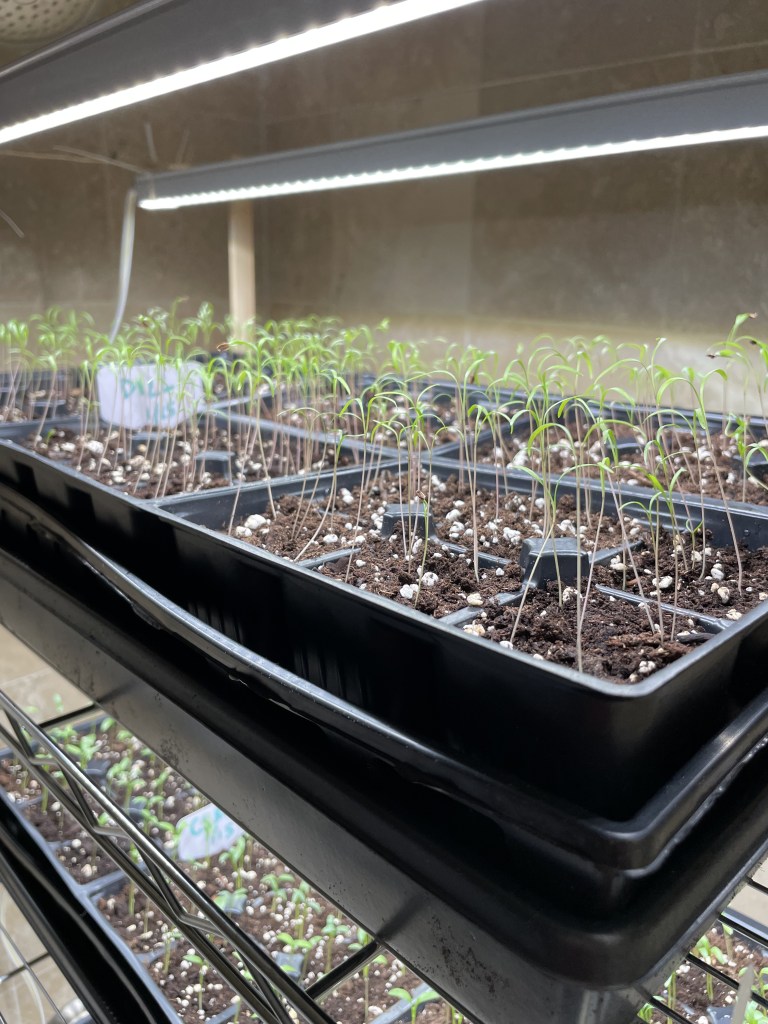
Two weeks later, everyone has sprouted and is looking great! I noticed right away that the dill seedlings were all leaning towards the one light I set up for them. I quickly go to work adding a second light to each shelf so they won’t have to strain as much to get to the light.

I’ve been spraying them with a spray bottle so I don’t overwater and kill the seedlings, but yesterday I gave everyone a good full water and they all seem to be happy. Without a full greenhouse type cover, I’m concerned about moisture levels. I will just keep an eye on everything.

Here’s a little “tour” from last night. Now I’m just waiting for those first real leaves to grow, hopefully this week.

Year of The Bean

9 May

I am determined to grow beans for long term storage. You might remember a few years ago I had great success with black eyed peas. Those guys lasted for over a year in glass jars. Cooked up nicely every time I tried them out.

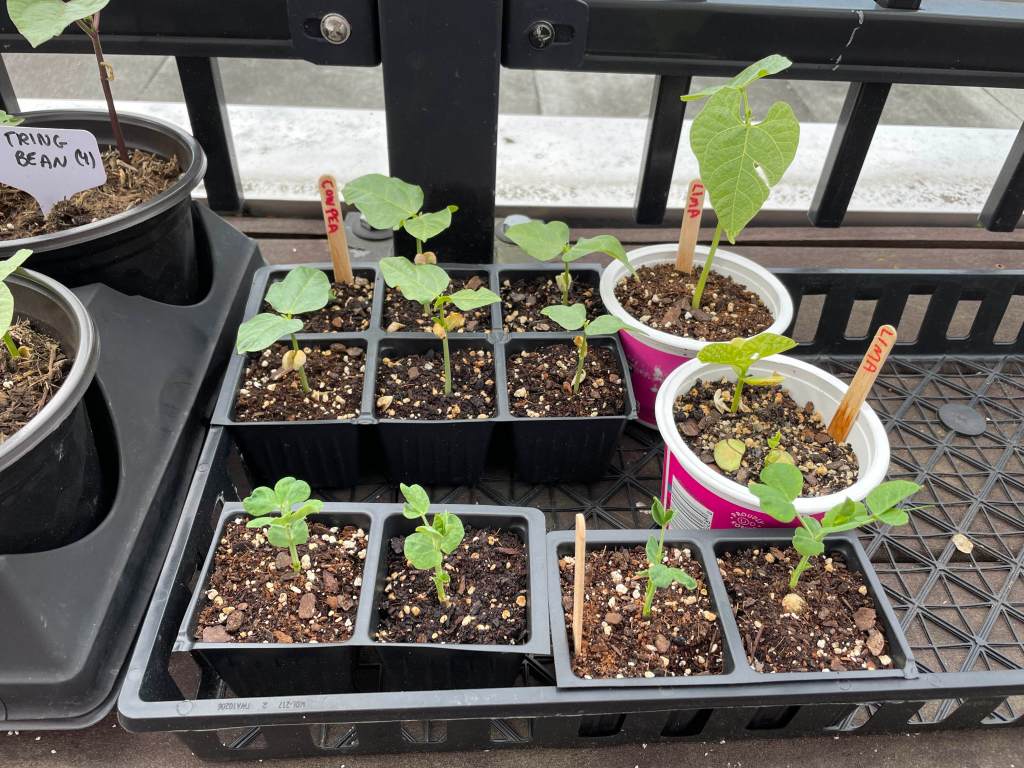
This year, I’ve already started snow peas, purple green beans, pink cowpeas (black eyed peas), lima beans (butter beans), and edamame. I plan to split them between the roof and the neighbor garden plot. My goal is long term storage, so I have several of each plant. I LOVE beans, and I’ve finally figured out how to cook them from dry. Argh. My years of canned beans might soon be over.

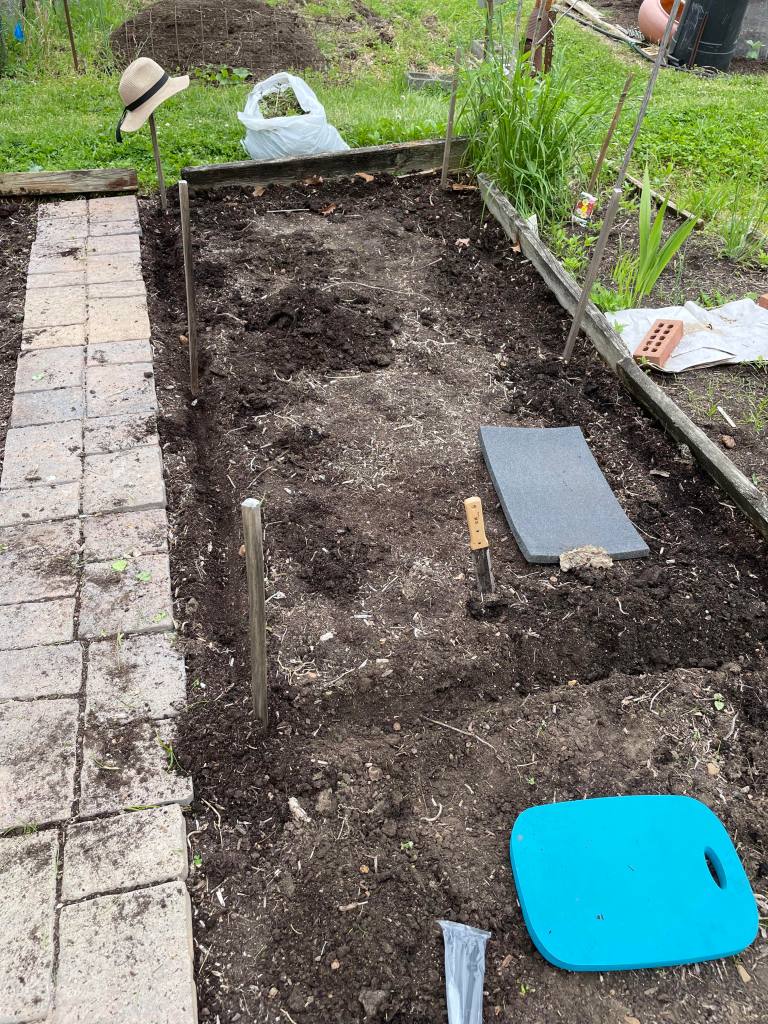
We’re trying to decide on a support system for the beans, but this past weekend we put in a “fluffy creature deterrent” to protect the smaller plants. Last year the rabbits ate all of our pepper and bean plants. They have lots of stuff to chose from, so this is just supposed to be a blocker. They likely won’t dig because they’ll just move on to the next plot. We still dug about 2″ down. Hopefully this will work, but we might also put some individual cages around the plants.

Kickoff 2021 with Plot Against Hunger & FOUA

21 Feb

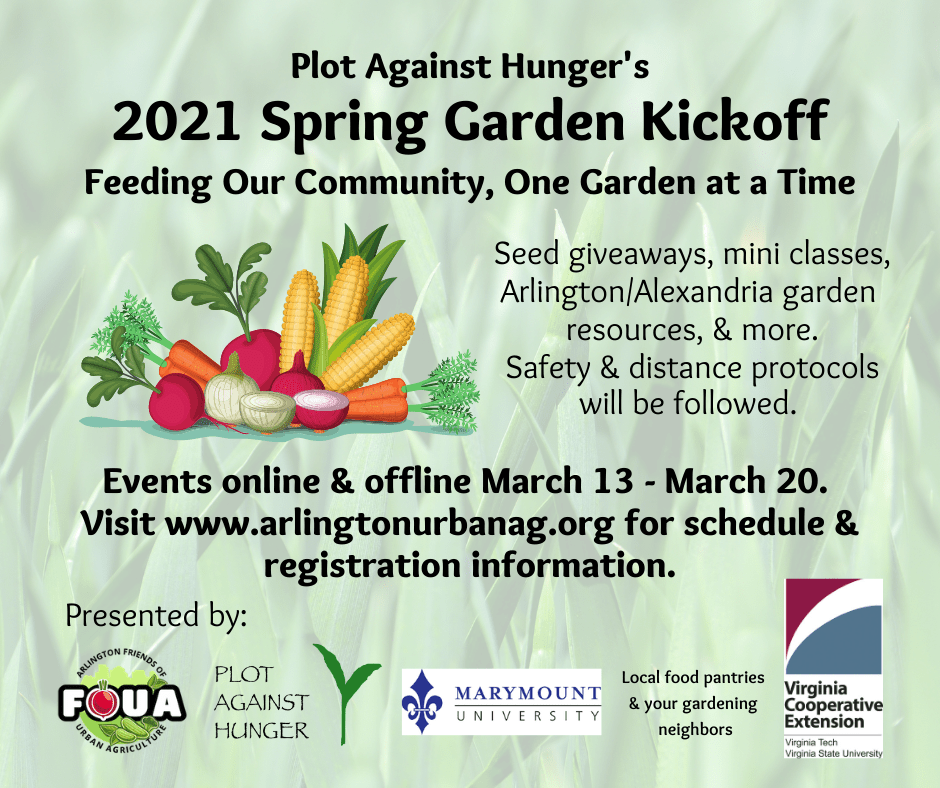
Arlington FOUA is the new official home for the Plot Against Hunger program! Formerly part of the Arlington Food Assistance Center (AFAC), Plot is a network of private home, community, and school gardens that raise fresh produce during the year to help feed our neighbors. Due to the pandemic, AFAC saw a significant increase in the number of clients needing food assistance and had to shift resources to focus on its core mission of providing free groceries to Arlington families in need in 2020. Along with growing food, Plot also supports a network of pantries that distribute the produce to clients in Arlington and parts of Alexandria. Here’s our full press release about the transition.

The Plot Against Hunger program will be a collaborative effort managed by FOUA that includes Arlington Virginia Cooperative Extension, Marymount University, Master Gardeners, Master Food Volunteers, food pantries, and individual gardens and gardeners. 

In addition to seed distribution events for participating gardens, we’re starting off the year with a big kickoff week of online events, some distanced demonstrations, and even some surprise giveaways. Here is more info, including a link to registration. If you’d like to get involved in Plot, you can contact me here or through the FOUA web site.

Please also observe my newfound design skills with this bangin’ promo poster.


Video

FOUA, School Victory Gardens, and an Interview!

19 Jun

Have I mentioned I’m on the board of directors of Arlington Friends of Urban Agriculture? FOUA is new as a 501(c)3, though the group was formed in 2017 out of Arlington County’s Urban Agriculture Task Force in 2015. Our mission is to build and support a fair, equitable, and sustainable food system in Arlington. I love talking about urban farming and small space gardening, so it’s right up my alley, huh? Plus, I get to use one of my advanced degrees yay!
A few weeks ago, I talked to the Ballston BID about urban agriculture in the county. Honestly, I was pretty nervous about how it would come out, but due to the producer’s magical editing skills, I think it’s pretty good! Here it is, all 27 minutes of listening glory.

We hit the ground running this year when we took on the COVID-19 crisis. A combination of factors lead us to our Victory Garden project that includes the new home of the Plot Against Hunger program (formerly of AFAC, the Arlington Food Assistance Center) and our school garden program.

With the approval of Arlington Public Schools, we are working with Arlington Virginia Cooperative Extension and garden coordinators at existing gardens to provide administrative support, volunteer bodies, trained Extension Master Gardeners, and in a very happy and unexpected twist, funding. When schools closed in March because of the pandemic, gardens struggled. Right before most gardeners begin their spring planting, volunteers and students were not allowed on school grounds. We presented our plan to the schools superintendent that FOUA would support the gardens by turning them into production gardens (or aiming to increase production for those that already were) and donate produce to a number of local food pantries that have seen a sudden and incredible increase in need. Our goal is 2,500 pounds by the end of this season. We started with three gardens in early/mid May and have made a ton of progress so far. We’re beginning to donate from each of the gardens. Plus, next week we’ll be onboarding a fourth school garden!

Follow us on social media for updates, on Instagram, Twitter, Facebook, and now YouTube (please subscribe so we can eventually get our own username!) I’ll be posting photos and making videos on a regular basis. Here are the first two videos I put together.


More updates as the season continues and our donations pick up.

Grow Some Tasty Grass For Your Bunny

26 Mar

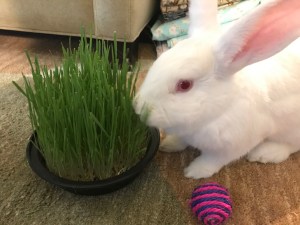
Want to make your buns super happy? Grow some fresh grass at home in under a week!

Equipment:

– Wheatgrass. (Buy in bulk for best price, usually under $2/pound. Look for hard winter wheat or wheat berries.)
– Clean containers of the same size that will stack into one another, plus one extra. (I like round plastic takeout style containers because they’re easy to clean and move around.)
– Potting mix. (Nothing special. Just a handful or two per container.)
– Heavy plastic. (Thickness of a ziplock bag, think. Anything will work, recycle if you can!)
– Water & love

1) Soak about 1/2 cup of wheatgrass overnight. This will wind up making about 2-3 containers worth, depending on the size of your container. I started with (L-R) buckwheat, wheatgrass, and barley. (We’ll ignore the barley and buckwheat for now. I don’t think the buckwheat sprouted properly, but the stuff I used was VERY old.)

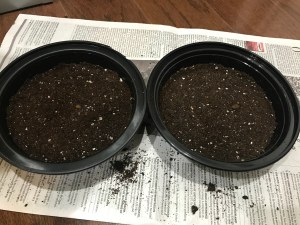
2) The next day, prepare your containers. I added about 3/4″ of potting mix to the clean containers, and then pressed it down using the other container. This part is important! You want to create a good base for your roots. (Wheatgrass doesn’t actually need a growing medium, but it takes way longer without.)

3) Sprinkle your soaked seeds over the prepared potting mix so you don’t see any mix, but try to get just a single layer. Water each container so the mix is saturated.

4) Cut a piece of plastic wide enough to cover your container, with an additional 1″-2″ all the way around. Place a piece of plastic on top of each layer of seeds, and put another container on top. Don’t stack more than three containers. The final layer should be an empty container with a gentle weight, like a jar.

4) No need to water, and no peeking! (Well, maybe just this once.) The seeds will germinate very quickly in the dark. Left photos are the day after planting, right is two days after planting, and time to move to the next step.
5) Unstack and put the containers in a box that you can easily close. I always throw a towel on top to keep the top and sides of the box closed. You want to block out as much light as possible. Leave the plastic lightly on top of the containers. Remove the plastic after the second day to avoid mold.
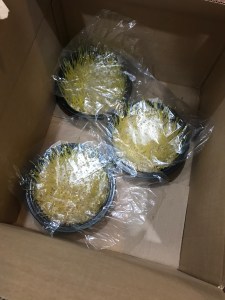
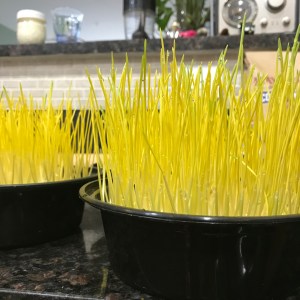
6) In about two days, you’ll have yellow grass about 3″-4″ tall. Take it out, put it in the sun (or even just indoor light), and it will continue to turn green and grow. Water just a bit every day from now on.

7) Once the grass has reached 5″-6″ in another day, you’re ready to serve! Total time: 6-7 days.

8) You can let him or her nibble on their own, or trim it and serve. Buns will eat down to the white part, where it will naturally regrow. You can get two good grow cycles, maaaaaybe three. Growth does slow down after the second trim, so I usually just toss the whole thing into the compost and start over. If you want to trim it yourself, cut at that same point.

Indoor update!

11 Mar

Since losing my garden last year, I’ve focused a lot more on indoor plants. This winter, however, I wanted to start some miniature tomato and pepper plants. I bought some grow lights and made this little set up. They were inexpensive and super easy to set up. I’ll probably move them around in a bit. They are connected to a timer, so I don’t have to remember to turn them on an off every day. 


The plants seem to LOVE the lights. I have to work on transplanting them all to larger containers. I’ll take care of that this weekend. The yellow fly tape is TERRIFIC. The fungus gnats are annoying, but they’re not interested in anything besides the plants.

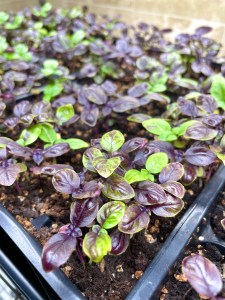
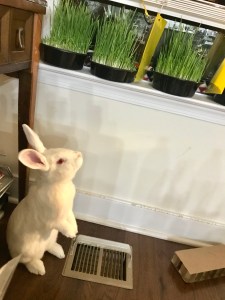
I started everything from seed in late Jan. (I always mark dates on the tags when I start.) Here I have micro tom tomatoes from Baker Creek, several kinds of purple and green basil, parsley, hot jigsaw peppers, and hot Peruvian aji peppers, and some dwarf sweet alyssum. The wheatgrass in the corner is for my bunny, Miss Elliott Hopsalot. I have a lot of that lining the windowsill, too.

Some of the basil will be donated to the Central Library’s Plot Against Hunger garden to go into the tanks in a few weeks. 

New year, new garden

3 Jun

Sad news to report, my garden friends.

In January, my condo board declared that I had to get rid of the marvelous tanks that brought greenery, vegetables, and enjoyment to the rooftop for years. Why? A bunch of weak reasonings, including weight (they had no idea how much the tanks weighed, plus they’re 1/3 styrofoam, remember, so they weigh less than 25 lbs psf fully loaded), “visuals” (I was told that people didn’t like them, except for all of my neighbors and the half-dozen realtors who included photos of the garden in condo listings since 2011), and basically that I don’t share, which was news to my neighbors who had been picking tomatoes, beans, herbs, and onions as they desire since I started.

Needless to say, I was crushed. But rather than fight what we were sure would be a losing battle, I decided to donate the tanks to the Arlington Food Assistance Center to be used to grow food for Plot Against Hunger. We moved the tanks in early March, and they are now happily growing food outside the Arlington Central Library.

I still have a garden, though it’s much smaller. The usual suspects, tomatoes, cucumbers, carrots, radishes, parsnips, kale, herbs, etc. This year I also have a number of hot peppers so I can make some sort of hot sauce. I’m also pleased to report that the asparagus we planted last year (that I had to remove from a tank and transplant) is doing really well! I’m hoping that by next year, I’ll be able to pick a few pieces.

More to update soon, including my presentation to members of the Arlington Friends of Urban Agriculture earlier this spring.